Northern Circuit Route
The Northern Circuit is Kilimanjaro's longest route, with wide views and few climbers. What to expect on the route, and our climbs on it.
Also on this route: 8 Days Northern Circuit, 9 Days Northern Circuit Route
Kilimanjaro climb
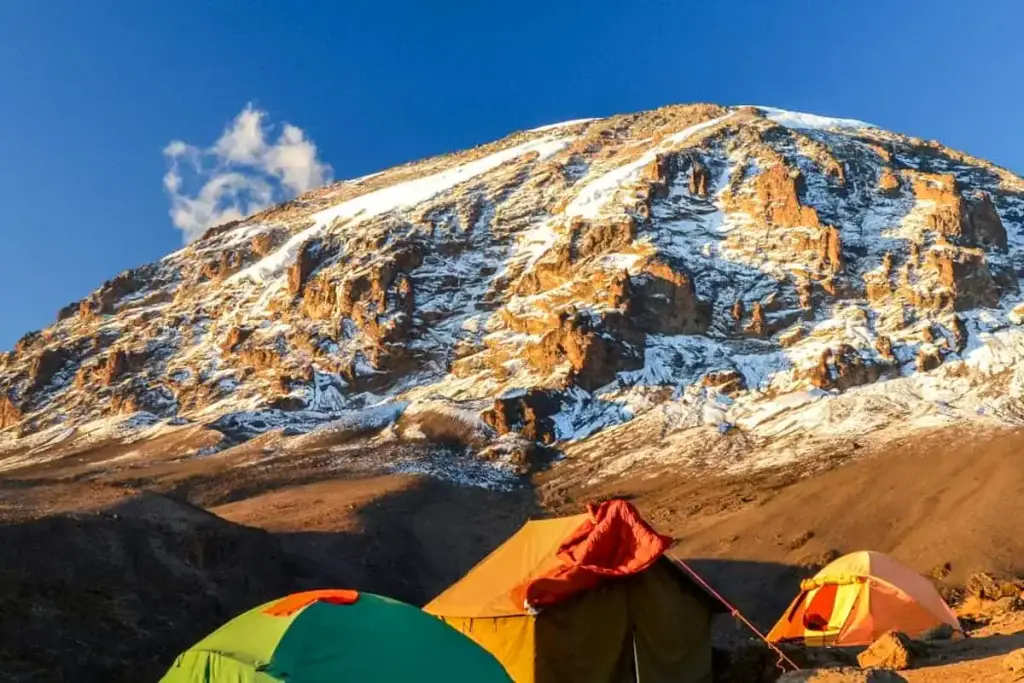
Kilimanjaro’s Northern Circuit takes the long way round, and that is exactly its appeal. It starts in the western forest, crosses the Shira Plateau, then leaves the busy southern trails behind and curves around the quiet northern side of Kibo before climbing to the crater rim from the east. It is the longest of the mountain’s established routes, and the slow, steady gain in height gives your body plenty of time to cope with the altitude.
The whole trip runs to eleven days. Nine are spent on the mountain, with an arrival day in Moshi at the start and a departure day at the end, so everything from the airport pickup to the flight home is arranged. The middle days bring long, up-and-down walks across high alpine country, with views north over the plains toward Kenya and very few other groups in sight.
Tanzania Tourism Safaris suggests this climb to hikers who value solitude and a gradual pace over speed, and to anyone who is uneasy about altitude. No technical climbing is involved, but good stamina for several long days in a row is essential.
You are met at Kilimanjaro International Airport and driven to your hotel in Moshi. Once you have settled in, the climb leader runs through the route day by day, explains how the crew works and goes through your kit with you, so you can rent or buy anything that is missing while there is still time. The rest of the day is yours to rest after the flight or wander into town. Dinner and overnight at the hotel.
After an early breakfast you drive west around the mountain, passing farming villages on the way to Londorossi Gate, where the park registration is done and the crew weighs and packs the loads. A vehicle then takes you up to the trailhead. The first walk is short and winds through old, moss-hung forest where black-and-white colobus monkeys are often seen. Camp is at Mti Mkubwa, Swahili for “big tree”.
This is a longer day with a big change of scenery. The last of the forest gives way to giant heather and open moorland as you climb over the Shira Ridge. On the far side lies the Shira Plateau, the broad, flattened remains of one of Kilimanjaro’s old volcanic cones. If the clouds lift, Kibo’s glaciers appear on the skyline to the east. You camp for the night at Shira I.
A shorter, easy-going walk takes you east across the plateau, a part of the mountain that relatively few climbers see. You reach Shira II by lunchtime. In the afternoon your guide leads a short hike to help your body adjust, with time to look at the Shira Cathedral, a huge buttress of rock topped with spires and pinnacles. The open views from camp are some of the widest on the climb.
Today you climb into the high alpine desert, where plants become small and scattered and the ground turns to rock and gravel. The trail rises toward the Lava Tower, the tall volcanic plug sometimes called the Shark’s Tooth, giving your body a taste of higher altitude. Instead of following the main southern trail, you then turn north into the quiet Moir Valley and camp below the Lent Hills, lower than the day’s high point.
The morning starts with a climb out of the Moir Valley. If everyone is feeling strong, a short side trip up the Lent Hills gives a fine view before you rejoin the circuit. From here the path rolls up and down across the northern slopes of Kibo, through country that sees very few trekkers. Buffalo Camp sits high on the mountainside with the plains of Kenya stretched out below.
A morning climb up Buffalo Ridge starts the day. After lunch on the trail you keep heading east around the mountain, through ever sparser alpine country, to Third Cave Camp on the upper Rongai trail. The camp is slightly lower than last night’s, and by now you have slept several nights above 3,500 m, so your body has had plenty of time to adjust before the final climb.
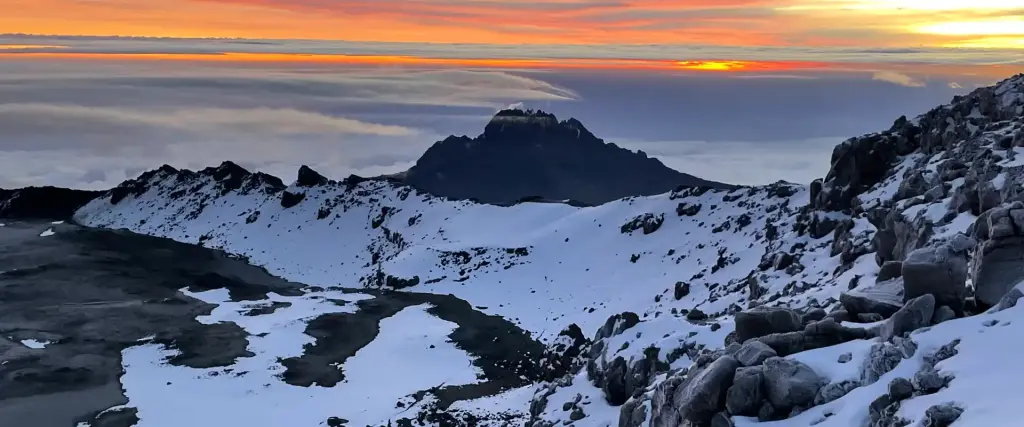
The last climb before the summit takes you up toward the wide, barren saddle between Kibo and Mawenzi, the mountain’s jagged second peak. The ground is stony and almost lunar, and the air is noticeably thinner. You turn toward Kibo and arrive at School Hut in time for a late lunch. The afternoon is for rest. Your guides check everyone’s gear, dinner is early and lights go out soon after.
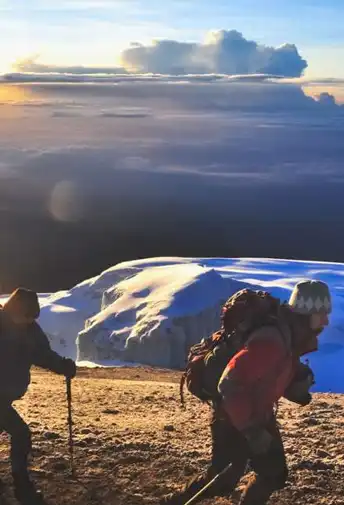
You set out around midnight by headlamp, climbing steep switchbacks to Gilman’s Point on the crater rim. After a short rest you follow the rim past Stella Point to Uhuru Peak, ideally as the sun comes up over the glaciers and ice cliffs. Take your photos, then turn around: the descent follows the southern slopes all the way down to Mweka Camp at 3,106 m (10,190 ft). Expect 11 to 15 hours on your feet, the longest day of the trip.
One more walk, and an easy one by comparison. The trail drops through the forest to Mweka Gate, often muddy in the lower section, so keep your gaiters on. At the gate you sign out and receive your summit certificate, and it is a good moment to say goodbye and thank the crew. Your driver then takes you to a hotel in Arusha for a long shower, a soft bed and a celebration dinner.
Enjoy a slow breakfast with nowhere to be and no hill to climb. Depending on your flight time, you can rest at the hotel, repack your bags or pick up a few gifts in Arusha. Your driver then takes you to Kilimanjaro International Airport for your flight home. If you would like to add a few days of wildlife viewing after the climb, we can plan a safari that starts from Arusha on this day instead.
Per person in US dollars. The price depends on when you travel and how many travelers share the trip.
| Season | 1 traveler | 2 travelers | 4 travelers | 6 travelers |
|---|---|---|---|---|
| Low season 1 Mar – 31 May | $2,520 | $2,136 | $2,028 | $1,832 |
| High season 1 Nov – 20 Dec and 6 Jan – 29 Feb | $2,653 | $2,249 | $2,134 | $1,928 |
| Peak season Now 1 Jun – 31 Oct and 21 Dec – 5 Jan | $2,948 | $2,499 | $2,372 | $2,143 |
Time and space. Nine days on the mountain let your body adjust to altitude slowly, which most people find makes summit night more manageable. The northern slopes are also far quieter than the southern trails, so you often have camps and viewpoints almost to yourselves.
From School Hut on the north-east side, you climb to Gilman’s Point on the crater rim, then walk along the rim past Stella Point to Uhuru Peak. The way down is different: you descend the southern slopes on the Mweka trail, spending the last night at Mweka Camp.
Summit day. You start around midnight in the cold and dark, climb for several hours at high altitude, then descend a long way to Mweka Camp. Day 5, from Shira II to Moir Camp, is also long. Building fitness with long hikes at home before you travel helps a great deal.
No. The Northern Circuit is a walking route with no ropes or technical climbing. What you do need is the stamina to walk for several hours on many days in a row, warm clothing for nights below freezing, and a willingness to walk slowly when your guide asks you to.
Route guide
The Northern Circuit is Kilimanjaro's longest route, with wide views and few climbers. What to expect on the route, and our climbs on it.
Also on this route: 8 Days Northern Circuit, 9 Days Northern Circuit Route
You might also like
Tripadvisor reviews
Excellent Trip of a Lifetime
Our family had the trip of a lifetime over the holidays. Our guides were amazing and always checked to make sure that we had everything we needed. In less than 2 weeks we got to do a short safari in Ngorongoro Crater, did a family visit as part of the cultural experience (my kids are still talking about how good the food was!!), visited Moshi for shopping, went to Dar Es Salaam and did a 2 day trip to Zanzibar. The logistics were all very smooth and the guides added humor and levity to the entire trip. We were in good hands and will never forget the hospitality shown to us while there. The best thing about the packages is that you can work with the team to tailor it to your exact timeline. We had to get back to work and school so opted for a short Christmas trip but we'll eventually go back to do a longer summer trip. Forever indebted for such a great experience!
Trip of a life time!! But why not go back?
BEST VACATION!!!! Eye opening, amazing, Beautiful and REAL. The safari was my favorite part. Seeing animals you learn about and dream of seeing right in front of your face. The food was great I ask you to be open and not get your norm. Safe? Yes. Of course there’s times you question a new country, area and people. There was never a moment I was in question of people or my surroundings. Next time I’m bring my kids they’re older and can help pay… hahaha. I heard it’s best not to go during the rainy Season it’s just easier and more enjoyable to get around. Just what people have said.
Great experience
Had a wonderful Safari experience in Nothern Tanzania. Got to see some Lions very closely. Best experience in a very long time tbh.
It was an amazing experience!
Awesome experience! Beautiful and exciting destination full of nature! We went during fall but anytime of the year is recommended. Planning for my next trip there!